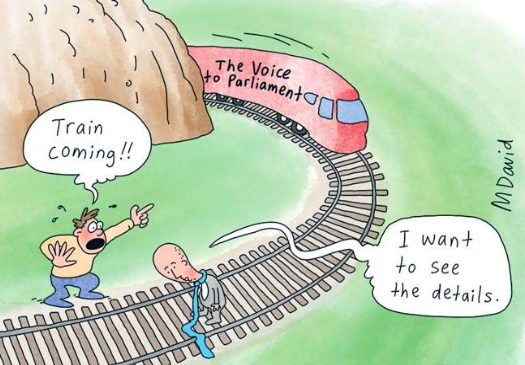
A historic vote has just taken place (Wednesday night 22.3.23) to pass the Referendum (Machinery Provisions) Amendment Bill in both houses of federal parliament. Opposition leader, Peter Dutton, gave Coalition support after securing some amendments in relation to the referendum on the Voice that will be held between October and December this year. (Cartoon by Independent News)
Whereas governments in the past had funded both the yes and no campaigns for referendums, the Albanese government had been planning to only fund an information campaign that would in essence be pro-voice and were seeking to censor misinformation, which people took to mean, no campaign arguments. They were also only granting tax-deductible gift recipient (DGR) status to the yes campaign. This was discriminatory. That mostly changed this week.
While Dutton was not able to secure funding for a no campaign, representations from the coalition have meant that the government will only be able to fund a neutral civics and education program so that any public funding on activities considered partisan can be legally challenged. Also, the no campaign can now benefit from DGR status.
There have been divisions with the referendum working group the government set up to advise it. These were over whether to include advice to executive government (public service and ministers) as well as parliament. When the Attorney General and Solicitor General raised concerns that including advice to executive government with the referendum working group, they were rejected. While the Solicitor Generals advice has not, and should be, made public, it appears the recommendation was to include “ministers of the crown” and not the public service.
Right up to the last minute, it looked like the Albanese government would end up in a big fight with the referendum working group over the final wording of what would be put to the public in the referendum. However, it was the Prime Minister (PM) himself who had added “executive government” into the wording for the Voice referendum he gave at the Garma Festival. So, despite the possible legal minefield and possible bogging down of government, the PM has agreed to their advice. As the PM has said in the past, it would be a brave government that did not take the advice of the Voice even if it is not a veto.
After cabinet approval, the PM (Albo as he is called) met with some of the 21 members of the Voice for a press conference on 23.3.23 to confirm the wording that would be put to the Australian public on referendum day. The consensus was nearly not there in time but the deadline was Thursday as there would be a final vote in parliament next week on the wording when a constitutional alteration bill will be put to parliament.
Albo was a bit teary as he is staking his political career on the referendum’s success as it will be a big part of his legacy. Albo’s draft amendment was, the Voice “may make representations to parliament and the executive government on matters relating to Aboriginal and Torres Strait Islander Peoples.”
The final wording the referendum working group put to cabinet who agreed to it is, “A proposed law: To alter the constitution to recognize the First Peoples of Australia by establishing an Aboriginal and Torres Strait Islander Voice. Do you approve this proposed alteration?”
On face value, this looks as simple a proposition as Albo keeps maintaining. However, the documentation accompanying it also says, that if it succeeds, the constitution will state that, the “Voice may make representations” to the Parliament and the government “on matters relating to Aboriginal and Torres Strait Islander peoples.”
This could mean anything and everything and it will include the public service. The details of the composition, functions and powers of the Voice will be worked out after the vote which means that there is still not the detail that many would like.
Prof Megan Davis of the referendum working group released the nine key design principles that will guide the Voice with details to be worked out after the referendum. The working group will stay in place to advise the government for a long time into the future till the Voice is established. Some of the design principles were in The Australian 23.3.23
- That the Voice provides independent advice to the parliament and the government
- That it is chosen by First Nations people based on the wishes of local communities
- That it is representative of Aboriginal and Torres Strait Islander communities
- That it’s empowering, community-led, inclusive, respectful, culturally-informed and gender-balanced and includes youth
- That the Voice is accountable and transparent and works alongside
- existing organisations
- The Voice will not have a veto and will not have a program delivery function
See the ABC report on announcements : https://www.youtube.com/watch?v=_dwC0xmBCKA
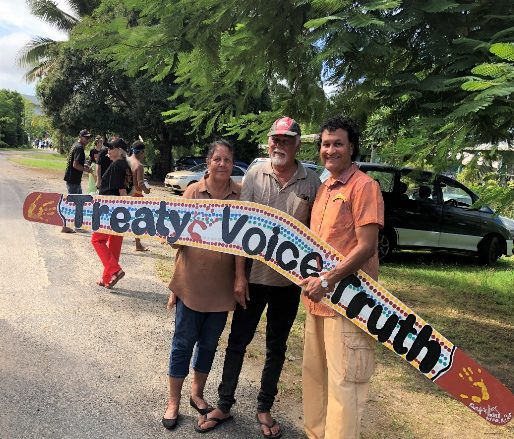
Megan Davis and other members of the Uluru Statement of the Heart visited Yarrabah Aboriginal community near Cairns for a meeting on Voice Treaty Truth on 10 April 2022. Why were they there? Because one of the few surviving campaigners of the successful 1967 referendum, Alf Neal, lives there. The 1967 referendum to count Aboriginal people in the constitution and give the federal government the power to legislate for Indigenous people had bipartisan support and was passed with over 90% support. Norman and I were invited to attend by the Mayor of Yarrabah, Ross Andrews and is pictured here with Alf’s son, former mayor Percy Neal.
So, what are the arguments for and against the Voice that people have been discussing?
Arguments for the Voice
- There should be constitutional recognition of Australia’s First Nations people. When the constitution was written in 1901, it was about the states coming together to form a commonwealth and so the focus was on delineating states’ rights and powers and commonwealth rights and powers – shared sovereignty if you want to put it that way. The First Peoples of Australia were left out of the constitution and this is a worthy argument to recognize them in it. This is why some commentators are saying that the wording of the referendum vote should be in two parts as there is a lot of support for constitutional recognition but a lot of debate about how to do it.
- First Nations people should be consulted on matters affecting them. Few would argue in principle about this. Again, it is about the process.
- It is another step towards reconciliation. There have been a number of significant steps in this direction. Albo is saying it would break the hearts of First Nations people for the referendum to fail and set back Indigenous affairs.
- Albo is saying that Australians would feel better about themselves if the referendum passes and Australia would look better in the eyes of the world. (See above video)
Launch of the Yes Campaign
The Yes Campaign was launched in Adelaide on 23.2.23 after workshops on strategies. The yes campaign director, Dean Parkin was upbeat. The Paul Ramsay Foundation, Australia’s largest philanthropic body, announced $5m in funding for Australians for Indigenous Constitutional Recognition (AICR), which will be the movement’s fundraising and governance body.
Their website, yes23.com.au, provides talking points for the volunteers it will recruit, and provide posters and flyers for the campaign.
The AICR co-chair, Rachel Perkins, well-known filmmaker and daughter of famous activist Charlie Perkins, said the campaign now had “tremendous momentum.”
Brief Background
Before going to the against arguments, I will give a little background on the long journey to recognition which I covered in detail in my book Secrets and Lies: The Shocking Truth of Recent Australian Aboriginal History, A Memoir. See www.barbara-miller-books.com. The big question is how to do that.
- Former Prime Minister John Howard wanted Indigenous recognition in the preamble to the constitution but First Nations people rejected this as not enough
- There have been a lot of processes over the years. Ps Munganbana Norman Miller campaigned for recognition of Indigenous people and removal of racism from the constitution based on the Expert Panel’s advice. He travelled Australia at his own expense and gathered over 5,000 signatures on a petition on these issues which was presented to federal parliament.
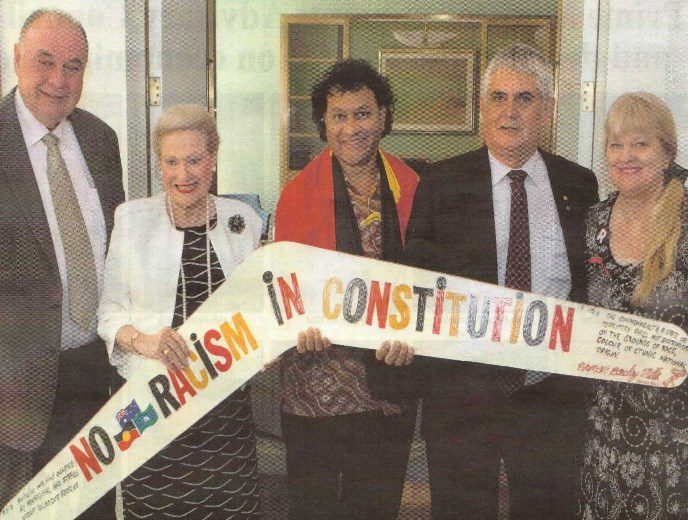
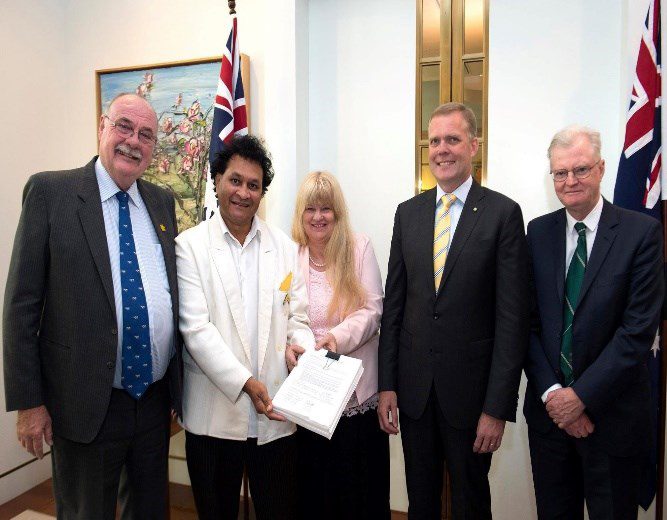
Warren Entsch MP Presents the Boomerang Petition to Parliament on behalf of Indigenous Leader Norman Miller https://www.youtube.com/watch?v=4LSEErGV1rI&feature=youtu.be
- The Uluru Statement from the Heart 40 years after the 1967 referendum came up with Voice Treaty Truth. The game plan had changed, apparently advised by sympathetic constitutional conservatives.
- The coalition government was prepared to work towards the Voice but to legislate it not have it enshrined in the constitution, and they continued consultations on how to design the Voice. Out of this came the Calma Langton report on the Indigenous Voice Co-design process.
- The Albanese government after winning the election committed to a referendum to enshrine the Voice in the constitution but have been prepared to release little information on it saying that would be worked out after the vote.
What are the opponents of the Voice saying?
Two no campaigns are being led by Sen Jacinta Nampijinpa Price and Nyunggai Warren Mundine, both Aboriginal. A group of traditional people from around the Northern Territory who oppose the Voice travelled to Canberra but were not given the courtesy of meeting Linda Burney, Minister for Indigenous Australians or the PM on March 22 when discussions were underway at Parliament House. Yet the PM said the Voice was informed from the bottom up not the top down. So here are the arguments:
- It will give us a race-based constitution and divide the country by race. Even the word apartheid has come up, and lack of equality of citizenship
- First Nations people will be double dipping with 2 “votes” or representations so that though they are only 3.2% of the population, they will have a special say over matters affecting all Australians
- However, they won’t be voted in, they will be selected. So, it will not be a democratic process.
- There are already 11 First Nations MPs which is higher than their proportion of the population.
- There are hundreds of Indigenous organisations and over 80 national organisations with a voice to the government already and have been advising the government for a long time.
- There is a Coalition of Peaks consisting of all these national organisations who negotiated with the government the updating of the Closing the Gap initiative. They are an effective voice already.
- There have been comments on Sky News re the National Indigenous Australian Agency having in its charter to be a voice to the government and it is very well-funded to do so but we must realize it is really a government department staffed by public servants, many of whom are Indigenous.
- Concerns that the Referendum group advising government are an elite or “aristocracy” and they will ensure they are still seated at the table as part of the Voice after the referendum.
- The biggest concern is that it may not make any difference to the disadvantage and problems on the ground for First Nations people but only create another bureaucracy that will divert a large amount of money from the real needs of people at Alice Springs and many other places.
- There may be legal challenges in the high court and judicial activism over the parliament or government not asking for their advice before making decisions or for not taking it. There have been arguments for and against by legal advisors in the Constitutional Experts Group e.g. Prof Greg Craven and Fr Frank Brennan who both support the Voice but have concerns. Prof Craven is also a member of Uphold and Recognise which seeks to uphold the constitution and recognize Indigenous people.
- Also, it could bog down the machinery of government and particularly of publicservants if they have to consult the advice of the Voice on just about everything. This is the reference to Executive Government which the Referendum group would not bend on despite the reported request from the Attorney General and the Solicitor General. It also appears from the statement today that National Cabinet and state governments will not be within the scope of the Voice.
- While there is a lot of information on what the Voice could look like e.g. the Langton- Calma report, the Albanese government have not said if they accept any of this report or not. Also, they have given out as little information as possible hoping that people will vote for it because of goodwill. This has led to a lot of confusion however and aloss of support. One example is Peter Dutton’s 15 questions submitted some time ago that have not yet been answered though today’s statement will go somewhat towards answering them. As this was an election tactic of a small target with little information the ALP used successfully to win the election, they seem to hope it will work with the referendum.
- It will be a trojan horse because, according to the Uluru Statement which the government accepts, the next step will be treaty or makarrata and truth-telling. There are concerns that demands for sovereignty will lead to Australia being divided into two nations. There are concerns treaties are meant to be between two nations but there are examples overseas of treaties between nations and their Indigenous people.
- There is a concern, which is under the surface, that First Nations people will want redress or compensation for lost lands and autonomy etc.
- Opposition to the Voice is from both the left and right of Aboriginal leaders. Sen Lidia Thorpe does not want First Nations representation in the “colonizing constitution” and has proclaimed herself one of the leaders of the Blak Sovereignty movement. Those who endorsed the Uluru Statement were hand-picked from meetings around Australiawhich were by invitation only or attended by those in the know. Some sovereignty supporters went to Uluru anyway and walked out because they did not agree with the decisions. They were in the minority.
- There has been no public consultation process, no constitutional convention with stakeholders and negotiations have been held in secret.
Albo said from the outset that he didn’t need bipartisan support and there has been little attempt to garner it. Referendums in Australia don’t tend to pass without bipartisan support and rarely do anyway unless they are about minor changes. The Nationals have opposed it and the federal Liberals will probably oppose it in its current form.
Former deputy prime minister John Anderson, Warren Mundine and others are members of “Recognise a Better Way,” a campaign that argues the Voice is “the wrong way to recognise Aboriginal people or help Aboriginal Australians in need”. https://theconversation.com/former-deputy-prime-minister-john-anderson-joins-group- spearheading-no-campaign-on-the-voice-195571
Jacinta Nampijinpa Price has moved from the Recognise a Better Way campaign to the no campaign of Fair Australia of Advance Australia, saying she does not want Australia divided by race https://www.skynews.com.au/australia-news/voice-to-parliament/northern-territory- senator-jacinta-price-defects-to-new-campaign-opposing-the-voice-to-parliament-ahead-of- referendum/news-story/e4076715009ebfc853e22af35b13941c
Nevertheless, Australia is at a crossroads on this matter of dealing with the Uluru Statement from the Heart. It is a momentous time. However, there is no doubt that this will be a radical alteration to Australia’s constitution with unforeseeable consequences if the yes vote is successful.